The Sober Lane: A Nonalcoholic Ale Guide for Pacing a Phoenix Ale Trail

Photo by Photo by SpotOn on Unsplash on Unsplash
Somebody in every group is not drinking. Sometimes it is the driver. Sometimes it is a Tuesday. Sometimes it is permanent, and the rest of the party has spent years pretending not to notice.
Phoenix taprooms have gotten noticeably better at this. The nonalcoholic section of a beer board is no longer a single dusty bottle of imported lager. Brewers here are putting their own names on NA releases, which changes the stakes — a brewery will not slap its flagship label on something it does not stand behind.
This is a practical guide, not a moral one. Whether you are chauffeuring four friends across the Valley or simply pacing yourself through a long afternoon, the goal is the same: something worth ordering, in a glass, that does not make you feel like an afterthought.
What the label actually says
Worth getting straight before you order, because the words are not interchangeable.
In the US, a beer labeled non-alcoholic can contain up to 0.5 percent alcohol by volume. That is roughly the level of a very ripe banana and lower than a lot of kombucha. It is generally considered acceptable for most people who avoid alcohol, but it is not zero, and anyone in recovery should decide for themselves.
A beer labeled alcohol-free or 0.0 should contain no measurable alcohol. Same for hop water, which is not brewed from grain at all.
Arizona does not restrict the sale of these products by age, and every taproom on this list will hand you one without a sideways look. What varies is whether they take the category seriously.
Three ways Phoenix brewers get flavor without the proof
Dealcoholization is not one process. It is a family of them, and the method shapes what the beer tastes like.
Arrested fermentation. The mash is built with less fermentable sugar, or the yeast is stopped early, so the beer finishes with almost no alcohol to remove. This works well for malt-forward styles — browns, porters, anything with roast character. It keeps body, because the sugars are still there. It struggles with hop-forward beers, because the yeast never got a chance to do the biotransformation work that makes modern hops taste like modern hops.
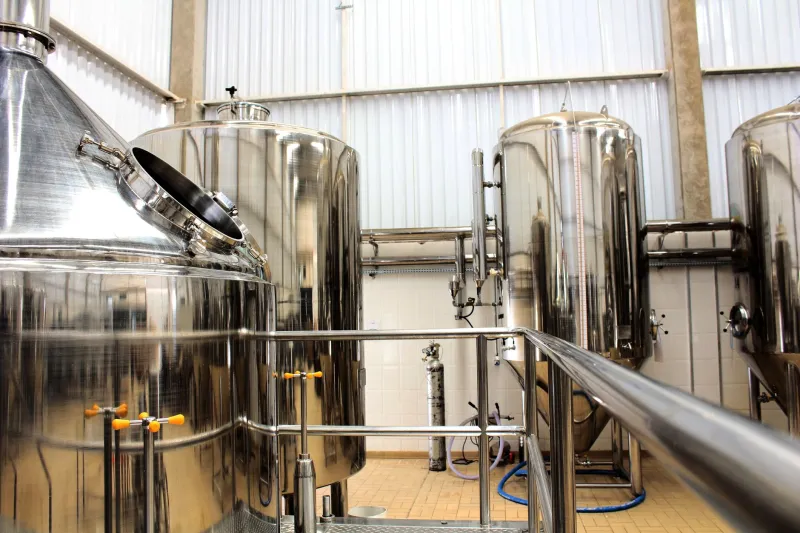
Vacuum distillation. The finished beer is gently heated under low pressure, which boils off alcohol at a temperature that does less damage to the rest of the liquid. It is efficient. It also strips aroma, which is why the brewer has to dose hops back in afterward.
Reverse osmosis. The beer is pushed through a membrane that separates alcohol and water from the flavor compounds, then the flavor is reassembled. Precise and expensive, and increasingly common for the better NA pales on the market.
The good local versions all share one trick: they rebuild body deliberately. Oat malt, cara malts, unfermentable sugars, a little extra wheat. Thin NA beer tastes thin for a mechanical reason, and a brewery that skips the fix produces something that reads as carbonated tea.
Hop water is not beer, and that is the point
Order a hop water expecting a pale ale and you will be disappointed. Order it expecting a dry, aromatic, zero-calorie sparkling drink with a green, resinous finish and you will be delighted.
Hop water is carbonated water, hop oils or dry hops, and often a touch ofCitric or lactic acid for brightness. No malt, no fermentation, no alcohol, no sugar. In a hot city it is genuinely excellent — it handles heat better than an NA beer does, because there is no malt sweetness to turn syrupy as it warms.
It is also the most reliable option in the room. Almost every Phoenix taproom with a decent beverage program has one now, and it beats a limeade by a wide margin when you are four hours into an afternoon and everyone else is on their second pour.
The taproom test: how to ask without making it weird
Plenty of bartenders get one NA question a week. A few get one a day. Either way, being specific helps.
Ask what is on the NA list rather than what is not alcoholic. It signals that you expect a list. Ask whether the NA pale is brewed in-house or brought in — both answers are fine, but the in-house ones usually come with a story, and a brewer who made an NA beer is generally happy to talk about why.
Skip the question about whether it tastes like real beer. It is a trap for everyone. It tastes like NA beer, which has improved dramatically and is still its own thing.
And if you are the person doing the driving, say so early. A taproom that knows you are the sober one in the group will bring you water without being asked, and a good one will time your food so you are not sitting there with an empty glass while the table eats.
Pairing NA ales with Sonoran snacks
NA beer is a little sweeter and a little less bitter than its full-strength cousin, so it wants salt, acid, and char.
Sonoran hot dog. The bacon-wrapped, pinto-topped, mayo-and-salsa situation. A roasty NA dark ale is the move here — it holds up to the smoke and the crema without competing.
Elote. Charred corn, lime, cotija, chile. Hop water is better than beer for this. High carbonation, no sweetness, clears the palate for the next bite.
Chips and a hot salsa. An NA pale with real hop bitterness is the answer. It cuts through the oil and stands up to chile heat better than a maltier pour.
Carne asada tacos. An NA amber or brown, if you can find one. The malt gives you something to push against the grilled meat and the flour tortilla.
Cheese crisps. A local bar-food staple, and a brutal pairing for anything delicate. Go hoppy, go cold, and drink it fast.
Building a sober-friendly route
The old model was one taproom, early exit. The better version uses Phoenix geography.
Start where there is food and shade — the afternoon sun is the real enemy, not the beer list. Plan a two-taproom walk rather than a four-taproom drive, and put the NA-heavy stop second, when everyone else has slowed down and the conversation has gotten good. Downtown Phoenix and the neighborhoods around Roosevelt Row, Grand Avenue, and the Mill Avenue corridor in Tempe all offer walkable clusters with more than one option for the person not drinking.
Call it a night when the driver calls it. That sounds obvious. It is also the part of the plan that gets renegotiated at 9 p.m. in every group in America.
One last thing, and it is the only etiquette rule that matters: do not make a production of the NA order. No toasts to the sober one. No jokes about the fake beer. Just let the person order a pint in a pint glass and get on with the evening. That is the whole point of the category finally being good — nobody has to explain themselves anymore.